
Project Spotlight: Humanoid Robotics and Embodied Artificial Intelligence (Euclid & MOIRA)
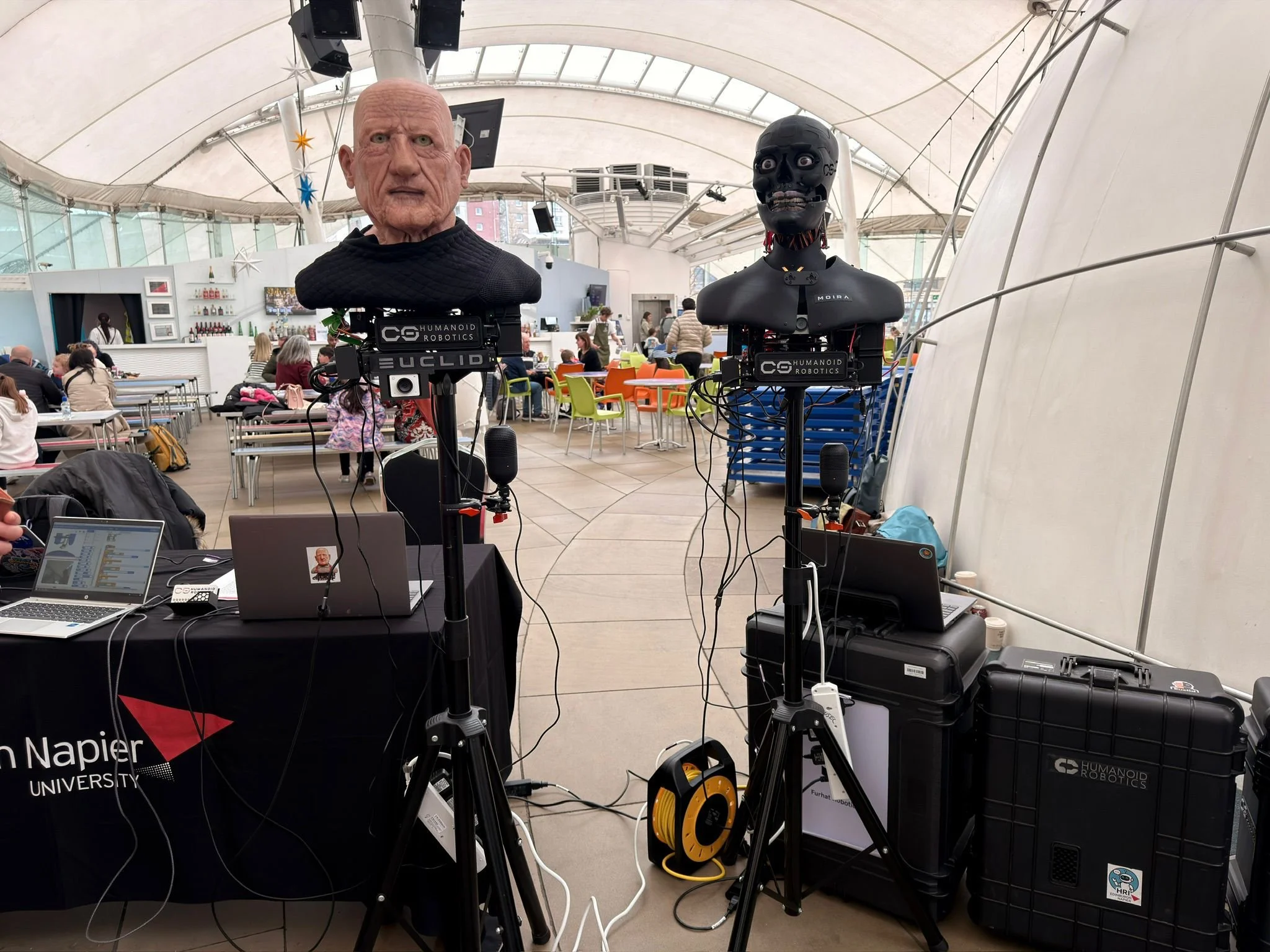
Euclid (left) and MOIRA (right). (Credit: Dr Carl Strathearn)
The work of the Scottish Partnership in Energy and Engineering Research & Innovation (SPEERI) spans key research areas in energy and engineering organised under ten strategic themes. Robotics and Autonomous Systems (RAS), one of our four engineering themes, covers the wide range of RAS research activity undertaken by our partner universities via sub-themes including transforming healthcare and improving quality of life, resilient and smart infrastructure, and the deployment of robots in extreme & hazardous environments.
This month’s case study spotlights the research of Dr Carl Strathearn, from Edinburgh Napier University, looking at his research into humanoid robotics and embodied artificial intelligence.
For those in attendance at our inaugural Annual Conference, in November 2025, you may have already met both Euclid and MOIRA.
We caught up with Carl to discuss his research and the potential applications. Find out more in the interview below.
1. Could you give us a brief introduction to your research in humanoid robotics & embodied artificial intelligence, and the projects you’re working on?
Carl: I build novel humanoid robots at home in my spare time, and my PhD students use them to develop and test their AI systems under the guidance of Emilia (Sobolewska) who is our Human-Robot Interaction (HRI) lead and User Experience (UX) expert. I started building these robots during my PhD because I was working on incredibly sophisticated software and hardware that could not be deployed on commercial robots.
I continue to build these robots today for my PhD students for the exact same reasons. For example, the robots currently run the latest Qwen 3.5 2-billion parameter vision language models (VLMs) integrated into the robots embodied AI framework. This allows the robots to see and speak about their surroundings, making interactions more natural and meaningful.
2. How did these projects come about? Was there a specific challenge you wanted to solve?
Carl: Other than the hardware and software challenges, the robots are unique in that they are highly adaptable so can be used for many different projects. We are currently doing small experiments in the lab where we get the robots to have a conversation with each other. For example, we give them the ground truth of one object on a table, and after a while they will hallucinate about what other related items may be on the table also. This is done through discussion between the models; the idea is to then move the table closer to the robots so they can see the other items and if they were correct about their assumptions.
With this approach we are wanting to emulate the human ability to make subconscious decisions, when we see things at a distance we may only know of one or two exact variables (an example would be when we see something in a shop that catches our interest, we would expect there to be similar items in that area related to it). So, we make predictions of what else may be in that area, we go over and look to confirm if what we thought was true or not.
This is still very early days, but what we have found so far is promising and may help robots to contextualise information more accurately through commonsense reasoning.
3. We met Euclid at our Annual Conference. Can you give us more details about how he works?
Carl: Euclid uses a series of onboard sensors that connect to a daisy chain of microprocessors which connect to a laptop. The reason for this is that we want to run everything locally on the robot, so no cloud AI. This allows us to use him anywhere without worrying about internet connections, etc. Also, we have full control over the data he collects from the spoken dialogues to image and video captures.
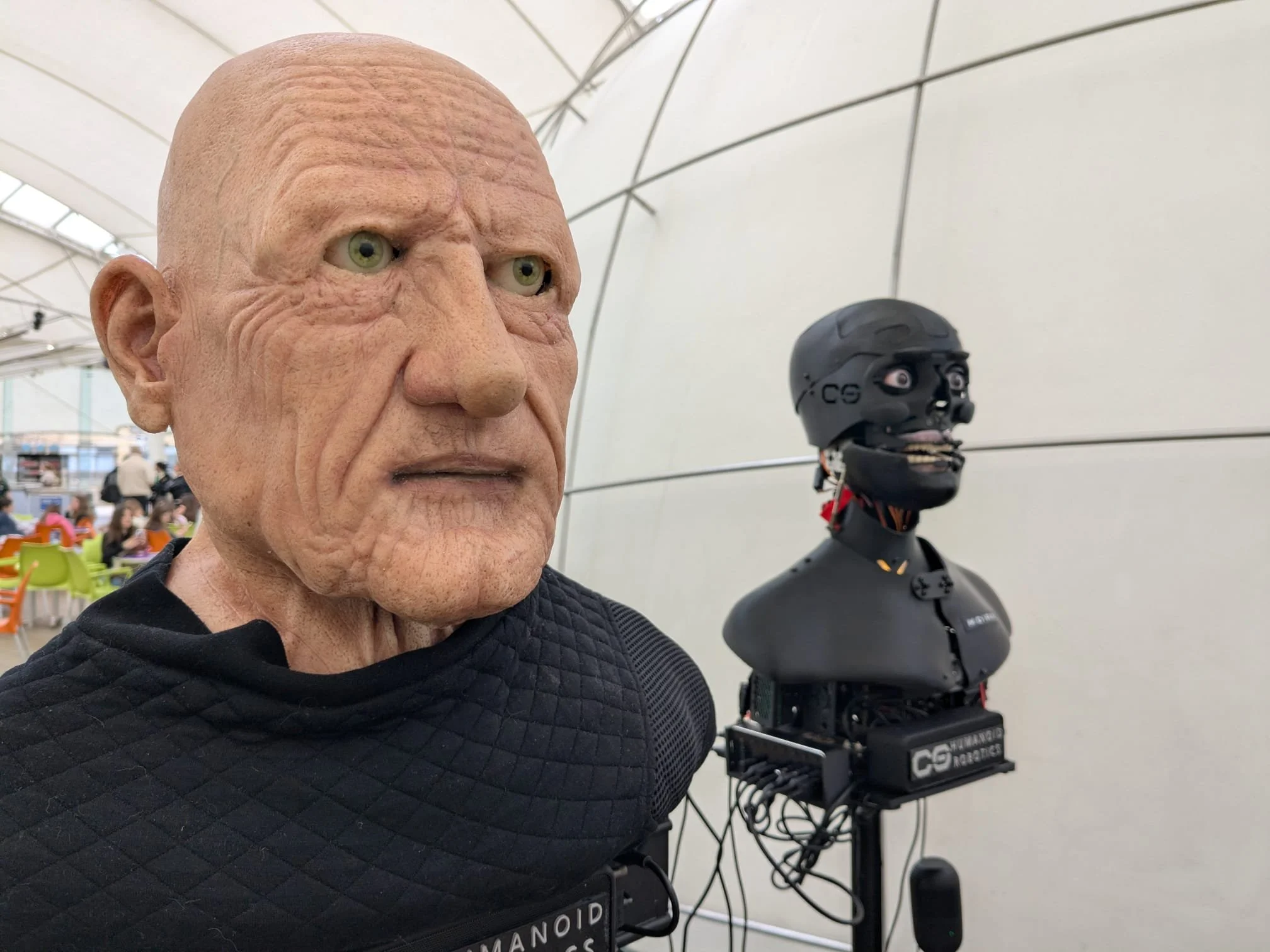
Euclid (left) and MOIRA (right). (Credit: Dr Carl Strathearn)
4. MOIRA is a ‘prototype modular humanoid robot with quick change parts.’ Can you explain the potential applications for a humanoid robot like this?
Carl: MOIRA represents what I believe humanoid robots will eventually become in the future. Even though humanoids are designed to use human tools and environments to avoid the need for bespoke ones, we still need adaptability in their appearance. MOIRA is a plug and play robot, in the sense that you can replace parts with other variations rather easily. Eyebrows, eyes, cheeks, and we are working on a changeable skin which can be directly applied to the robot.
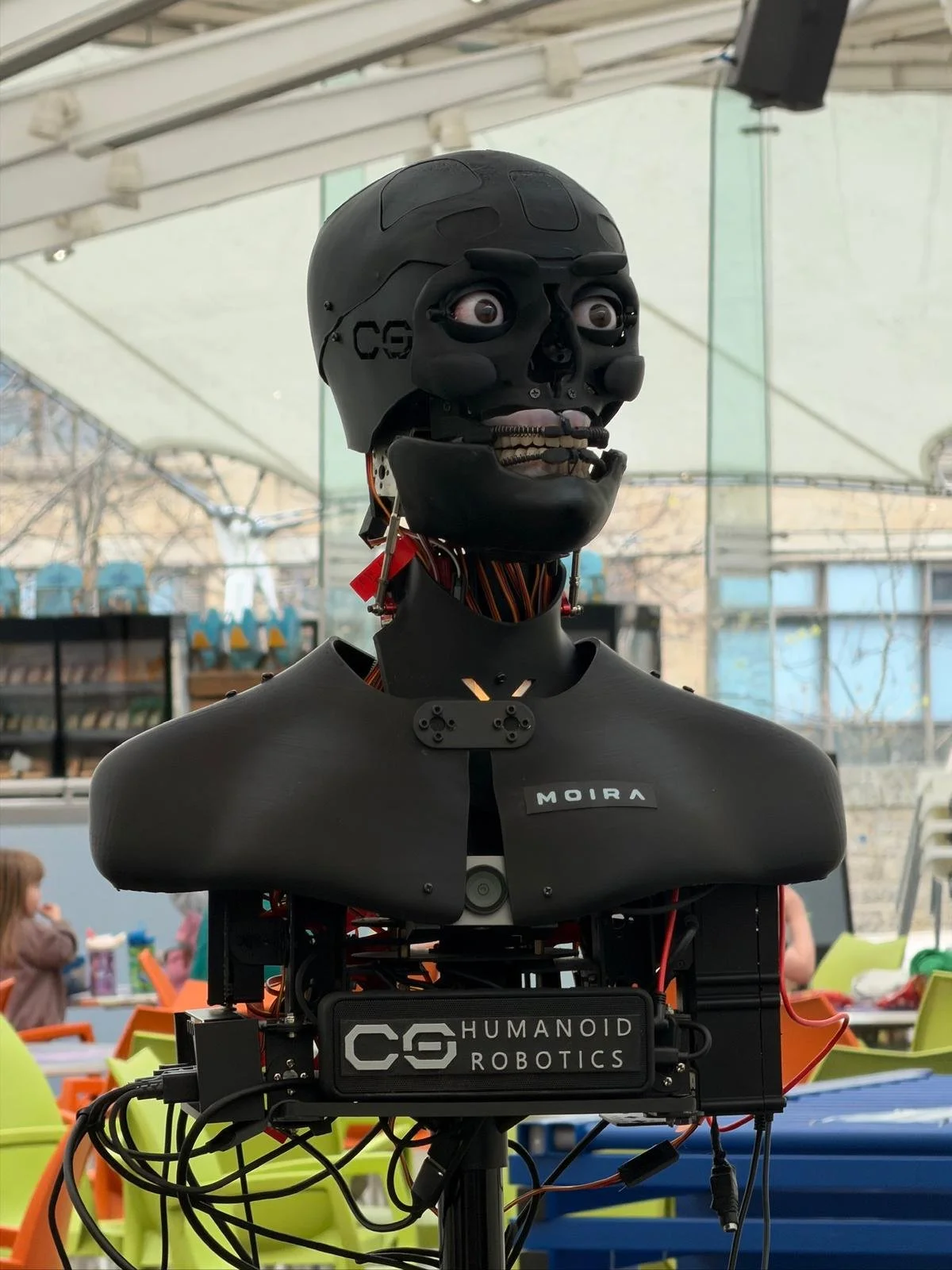
MOIRA. (Credit: Dr Carl Strathearn)
5. What are some of the potential applications for your other research into humanoid robotics and embodied artificial intelligence?
Carl: This is always tricky to answer; I believe that there are genuine use cases for humanoid robots in society. These are typically areas that would either help assist/educate people or be used in place of humans in very dangerous situations. However, we are already seeing misuse of the technology – for example, there’s a data deficit in Visual-Language-Action (VLA) video data to train robots to do physical tasks, and AI companies are forcibly scraping this data from sweatshop workers. So, there are massive ethical implications here, and it is understandable why people have concerns about robots and AI taking over jobs in the future.
6. Your work includes everything from programming to CAD design to human biology. It seems quite interdisciplinary. How does cross-disciplinary working benefit your research?
Carl: It’s now a necessity. One thing I am seeing more and more is that graduates leave university and are only able to hit about 40% of the required skills on job applications in my field (and related). We see terms like ‘full stack’ and ‘end to end’, which require the ability to problem solve across many different areas and understand the complete picture rather than just the individual pieces of the puzzle.
In my research, having this skillset is crucial because I need to understand everything that the robot is doing in order to problem solve and master its limitations. This is a massive issue in my field right now. We are seeing the push for social robots to be used for all sorts of domains including healthcare, but at the same time, the limitations of these robots make them completely unsuitable for such tasks. Therefore, we always promote that people should build their own robots rather than buy them off the shelf, so they fully understand how the robots work and their advantages and limitations before conducting research.
Watch SPEERI Business Development Manager (Hydrogen), Natasha Madeira, chat with Euclid at the SPEERI Annual Conference 2026.
