
Project Spotlight: METASIS
METASIS is a collaborative project led by SPEERI partner Robert Gordon University. We chatted with project lead, Professor Nadimul Faisal (Robert Gordon University), about the project. Check out the full interview below.
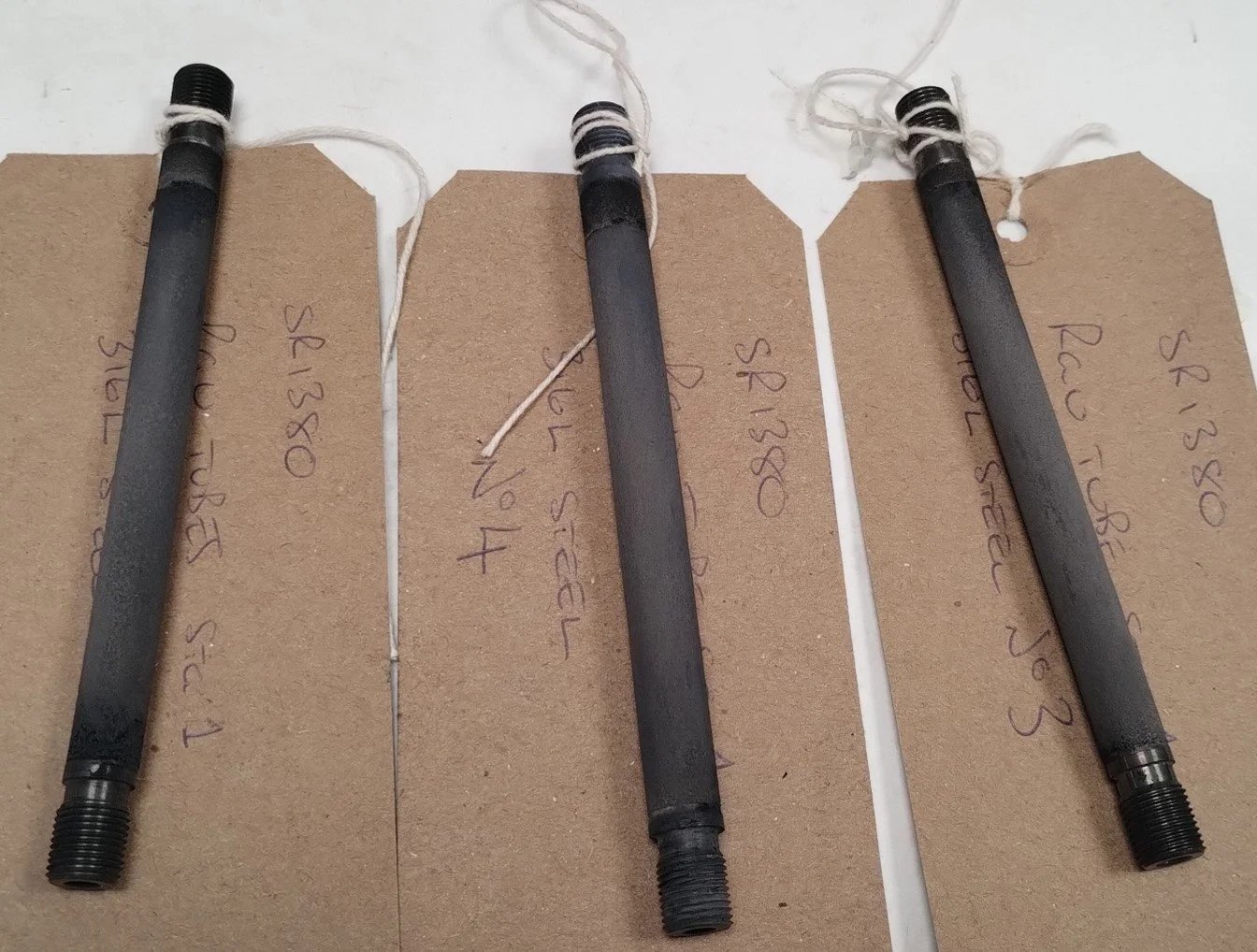
Image: METASIS tubular SOSE (Solid Oxide Steam Electrolysis) electrodes that can be mounted into a reactor housing.
Could you give a brief introduction to the METASIS project? What are your aims and how did the project come about?
METASIS is an EPSRC-funded research programme advancing next-generation solid oxide steam electrolyser (SOSE) technology for clean hydrogen production. The project is led by Robert Gordon University in collaboration with the University of Surrey, Aston University, and the UK National Nuclear Laboratory (UKNNL), alongside national and international academic and industrial partners.
Our vision is to enable highly efficient, scalable hydrogen production systems that support the UK’s transition to a secure, low-carbon energy future. Our mission is to design, develop, and demonstrate a novel meta-structural tubular SOSE architecture that enhances performance, durability, and manufacturability compared to conventional electrolysis systems. This is possible while maximising overall system efficiency through the integration of high-temperature heat from nuclear and industrial waste sources.
METASIS brings together expertise in materials science, electrochemistry, advanced manufacturing, and nuclear and renewable energy integration to address key technical barriers that currently limit the widespread deployment of solid oxide electrolysers. By combining advanced cell architecture with effective heat integration strategies, the project aims to bridge the gap between laboratory innovation and real-world, high-efficiency hydrogen production systems.
Unlike low-temperature electrolysers, solid oxide systems operate at elevated temperatures (typically 600 °C to 950°C), allowing part of the energy required for hydrogen production to be supplied as heat rather than electricity. This creates a major opportunity to utilise high-temperature waste heat from industrial processes, advanced nuclear systems, and other thermal energy sources, improving efficiency, lowering electricity demand, and reducing the overall cost of hydrogen production.
The project idea was conceived during COVID-19 in response to the growing need for high-efficiency hydrogen technologies aligned with national policy frameworks such as the UK Hydrogen Strategy (2021), Net Zero Strategy (2021), and the British Energy Security Strategy (2022). Hydrogen is widely recognised as a key enabler in decarbonising hard-to-abate sectors, including heavy industry, transport, and power generation.
METASIS also builds on the principal investigators’ previous pioneering work on molten metal anode solid oxide fuel cells (MMA-SOFC) and scalable metasurface manufacturing, combination of which provided valuable insights into high-temperature electrochemical systems, advanced materials behaviour, and innovative cell architectures. This prior research laid the scientific and engineering foundations for developing the meta-structural tubular solid oxide steam electrolysis approach now being advanced through METASIS.
There are a number of partners working on METASIS, how has the collaborative nature of the project benefited the work you’re doing?
The collaborative structure of METASIS has been fundamental to its success. Each collaborator and partner brings complementary and highly specialised expertise that strengthens the overall programme.
Robert Gordon University leads the project, driving system design, advanced manufacturing approaches, and the development of the novel meta-structural tubular architecture. The University of Surrey brings internationally recognised strengths in electrochemical characterisation, modelling, and optimisation of solid oxide systems, supporting performance validation and design refinement. Aston University contributes deep expertise in life cycle assessment (LCA) and techno-economic analysis (TEA) to analyse the viability of SOSE for commercial applications, helping to improve durability and long-term operational stability. The UK National Nuclear Laboratory provides critical knowledge on nuclear heat integration, safety, and deployment pathways within real-world energy systems.
We are partnering with wider national and international academic and industrial partners contribute to materials processing, scale-up strategies, manufacturability, and commercial translation, ensuring that the research remains aligned with practical implementation requirements. It includes Ceres Power, Sizewell C, QinetiQ, We Are Nium, Severn Thermal Solutions Limited, CPH2, C-Capture, ETZ Ltd, Delta H Consulting Ltd, UKAEA Joint Chair in Materials for Fusion (University of Birmingham), Centre of Excellence in Coatings & Surface Engineering (University of Nottingham), Dalton Nuclear Institute (University of Manchester), Brilliant Energy Institute (Ontario Tech University), UK-HyRES, Energy Research Accelerator (ERA), ScotCHEM, UK Metamaterials Network (UKMMN), Hydrogen Scotland, Henry Royce Institute, Engin-X (STFC), and Surrey's Ion Beam Centre (UKNIBC).
Working across institutions enables us to address challenges from multiple perspectives, combining fundamental science with engineering innovation and deployment planning. This integrated approach accelerates development, reduces technical and commercial risk, and ensures that the technology we are advancing is aligned with national energy strategy, industrial decarbonisation needs, and the UK’s long-term Net Zero ambitions.
The METASIS technology, meta-structural tubular solid oxide steam electrolysis (SOSE), is a pioneering method of producing clean hydrogen from electricity and heat from renewable and nuclear sources. What makes this technology stand out against other types of electrolysers?
What distinguishes METASIS is its novel meta-structural tubular architecture combined with high-temperature steam electrolysis. Unlike low-temperature electrolysers (such as alkaline or PEM systems), solid oxide systems operate at elevated temperatures (typically 600 °C to 950 °C), which significantly improves electrical efficiency because a portion of the required energy is supplied as heat rather than electricity.
A key focus of METASIS is the selection and development of advanced materials that enable efficient operation at reduced temperature ranges within solid oxide systems. By optimising electrode, electrolyte, and interconnect materials, the project aims to lower the effective operating temperature while maintaining high performance. Reducing temperature helps minimise degradation, improve durability, expand material compatibility, and lower system costs, all of which are critical for commercial deployment. This high-temperature (and optimised intermediate-temperature) operation creates a major advantage: the ability to utilise high-temperature waste heat from industrial processes, advanced nuclear reactors, or concentrated renewable thermal systems. By integrating external heat sources, the electrical energy demand is reduced, improving overall thermodynamic efficiency and lowering operational costs.
Compared with conventional planar designs, the tubular configuration offers advantages in thermal stress management, mechanical robustness, and system integration, making it particularly suitable for coupling with nuclear and industrial heat sources.
The METASIS project is in its second phase, with METASIS 2.0 being funded by EPSRC. How has the METASIS project evolved with this new round of funding?
METASIS 2.0 builds on the foundational research from the first phase by moving further toward multi-stack tubular SOSE development.
In the first phase (EP/W033178/1), we validated key design principles and demonstrated single-tubular cell performance improvements. We conducted a range of basic designs, simulations, materials selection, manufacturing, and performance testing. The study led to the development of a single tubular steam electrolyser unit by using porous metal (stainless steel, titanium) tubes as the supporting layer. In addition, thermomechanical stress analysis contributed to further improvements in the overall design of tubular SOSE cells and, therefore, potential impact on reducing time-to-market for steam technology. The choice of materials and fabrication methods (thermal spray coating, dip coating, electrochemical deposition) used in METASIS played a crucial role in achieving the desired properties and overall cell performance. Findings highlighted key relationships between microstructure, material choice, and electrochemical performance, as well as challenges related to durability and scale-up.
Our current research addresses:
functional material development, characterisation and experimental analysis of the SOSE performance,
modelling, fabrication and testing of the modular SOSE unit,
life cycle and techno-economic assessment to analyse the viability of SOSE for commercial applications,
benchmarking nuclear steam deployment for SOSE & stakeholder engagement.
With METASIS 2.0, we are refining materials, improving manufacturability, and addressing long-term durability and scaling challenges. There is also a stronger emphasis on integration pathways, considering how the technology can connect with nuclear heat sources in realistic operating environments. This evolution reflects a shift from early-stage innovation toward deployment readiness, while continuing to advance the underlying science.
What are the biggest technical challenges in developing solid oxide steam electrolysers?
Solid oxide systems operate at high temperatures, which creates challenges in multi-layer and multi-material durability, thermal stress management, and long-term stability. Repeated heating and cooling cycles can degrade components if not carefully engineered, particularly at the interfaces between different materials where thermal expansion mismatches can occur. A key focus within METASIS is to address these challenges by developing and selecting advanced materials that could enable efficient operation at reduced temperature ranges (270 °C to 600 °C). By optimising electrode compositions, electrolyte materials, and interconnect technologies along with metal supported system, we aim to lower operating temperatures while maintaining high electrochemical performance. Reducing the temperature of operation can significantly decrease material degradation rates, improve structural stability, broaden material compatibility, and enhance overall system longevity. Another challenge lies in scaling manufacturing processes while maintaining performance and reliability.
What does the future look like for METASIS? What would implementation of solid oxide steam electrolysers look like for the UK’s target of achieving Net Zero by 2050?
The future of METASIS is closely aligned with the UK’s Net Zero strategy. Solid oxide steam electrolysers have the potential to provide high-efficiency, large-scale hydrogen production that supports decarbonisation across multiple sectors. In practical terms, implementation could involve coupling solid oxide electrolysers with next-generation nuclear power stations, geothermal plants, and industrial clusters. These systems could convert surplus electricity and high-grade heat into hydrogen for use in steelmaking, chemical production, heavy transport, and long-duration energy storage.
Importantly, the UK’s industrial sector generates approximately 48 TWh per year of waste heat, of which around 11 TWh per year (2.2 MtCO2/yr) could potentially be recovered for useful purposes through specially designed energy conversion technologies. High-temperature solid oxide electrolysis provides a pathway to harness part of this otherwise underutilised energy stream, improving overall system efficiency and reducing the electricity required for hydrogen production. By improving efficiency, durability, and effective heat integration, METASIS aims to reduce costs and accelerate commercial adoption. If successfully deployed at scale, this technology could become a cornerstone of the UK’s low-carbon hydrogen infrastructure and play a significant role in achieving Net Zero by 2050.
How does METASIS contribute more widely to the innovation and research landscape?
Beyond technological innovation, METASIS team plays an important role in knowledge exchange and in the development of the next generation of researchers and engineers. The project supports students, early-career researchers, and interdisciplinary collaboration across partner institutions. METASIS team members also actively engages with the wider research and industrial community by regularly organising webinars and participating in knowledge-sharing course (e.g., ‘Hydrogen Energy Systems’ upskilling course at RGU). METASIS webinars provide a platform for disseminating research findings, fostering dialogue with industry and policy stakeholders, and encouraging collaboration across academia, national laboratories, and the private sector. They also create valuable opportunities for early-career researchers to present their work and expand their professional networks. Working at the intersection of energy systems, materials science, and engineering helps build a highly skilled workforce equipped to tackle the UK’s long-term energy security and sustainability challenges. Through training, outreach, and open engagement, METASIS contributes not only to technological advancement but also to strengthening the UK’s hydrogen innovation ecosystem.
What impact could METASIS have on industry and the wider economy?
METASIS technology could significantly strengthen the UK’s position in advanced hydrogen technologies and high-temperature electrochemical systems. This would create opportunities across manufacturing, specialist materials supply chains, advanced engineering services, and the export of UK-developed expertise. A core part of the METASIS programme is the delivery of clearly defined key performance indicators (KPIs). These include improving hydrogen generation more efficiently (above 90%), enhancing durability under high-temperature conditions, increasing power density, improving structural robustness, and demonstrating scalable, manufacturable tubular designs.
The project also aims to reduce degradation rates, extend operational lifetime, and lower the projected levelised cost of hydrogen (LCOH) through effective integration of high-temperature waste and nuclear heat. By achieving these KPIs, METASIS seeks to demonstrate not only technical feasibility but also commercial viability. Developing efficient solid oxide electrolysers domestically could reduce reliance on imported technologies, strengthen UK energy security, and stimulate high-value job creation in clean energy manufacturing and systems integration.
What message would you like to share with industry partners or potential collaborators?
The global solid oxide electrolysis cell market size was valued at US $118.71 million in 2024 and is projected to grow from US $208.78 million in 2025 to US $11,687.75 million by 2032, exhibiting a CAGR of 77.71% during the forecast period (Fortune Business Insights, 2024-25). Collaboration and developing supply chain network is essential to delivering transformative energy technologies. We welcome engagement from industrial partners interested in hydrogen production, advanced manufacturing, energy systems integration, and Net Zero innovation. By working together across academia, industry, and government, we can accelerate the path from research to real-world deployment and maximise the societal impact of clean hydrogen technologies.
